
Nicole Helbert
Write-in candidate for Mayor of Richlands
Read this sheet as text
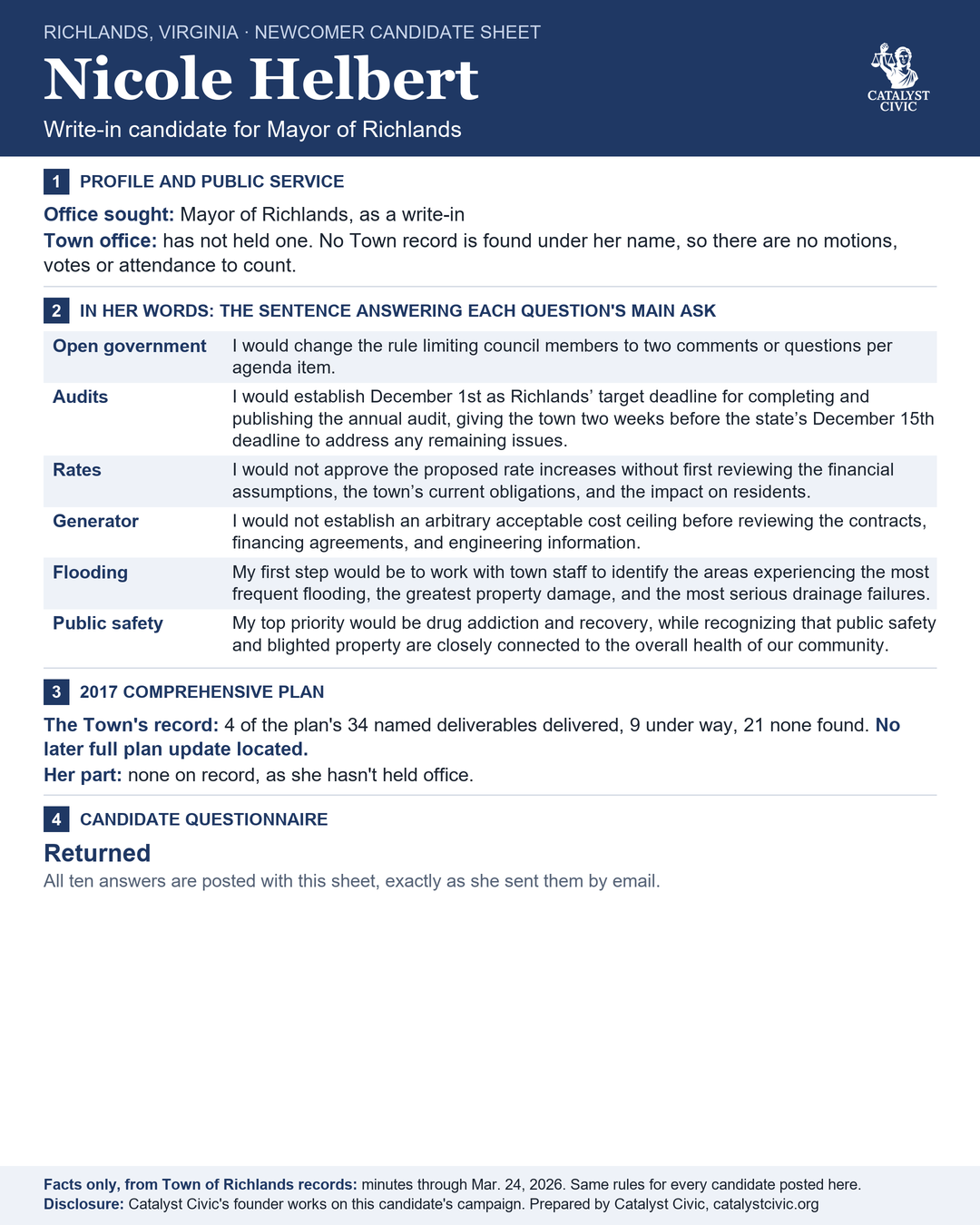
Nicole Helbert Richlands, Virginia · Newcomer candidate sheet Write-in candidate for Mayor of Richlands 1. Profile and public service Office sought: Mayor of Richlands, as a write-in Town office: has not held one. No Town record is found under her name, so there are no motions, votes or attendance to count. 2. In her words: the sentence answering each question's main ask Open government: I would change the rule limiting council members to two comments or questions per agenda item. Audits: I would establish December 1st as Richlands’ target deadline for completing and publishing the annual audit, giving the town two weeks before the state’s December 15th deadline to address any remaining issues. Rates: I would not approve the proposed rate increases without first reviewing the financial assumptions, the town’s current obligations, and the impact on residents. Generator: I would not establish an arbitrary acceptable cost ceiling before reviewing the contracts, financing agreements, and engineering information. Flooding: My first step would be to work with town staff to identify the areas experiencing the most frequent flooding, the greatest property damage, and the most serious drainage failures. Public safety: My top priority would be drug addiction and recovery, while recognizing that public safety and blighted property are closely connected to the overall health of our community. 3. 2017 Comprehensive Plan The Town's record: 4 of the plan's 34 named deliverables delivered, 9 under way, 21 none found. No later full plan update located. Her part: none on record, as she hasn't held office. 4. Candidate questionnaire Returned All ten answers are posted with this sheet, exactly as she sent them by email. Facts only, from Town of Richlands records: minutes through Mar. 24, 2026. Same rules for every candidate posted here. Disclosure: Catalyst Civic's founder works on this candidate's campaign. Prepared by Catalyst Civic, catalystcivic.org
Her questionnaire answers
Her exact words, copied from the answer boxes in the PDF she returned. They were not edited or fact-checked for this page. Answers 7, 8 and 9 appear cut off on the pages of her PDF because those boxes are too small, so the full text is here.
1. Council debate rules and the rights of every member
I would change the rule limiting council members to two comments or questions per agenda item. Meaningful debate, thoughtful questions, and public accountability should never be restricted simply because a discussion becomes uncomfortable or takes longer than expected. Council members have a responsibility to understand the issues before making decisions that affect residents. I would support reasonable rules that keep meetings organized, prevent repetitive arguments, and ensure everyone has an opportunity to speak. However, members should be allowed additional questions or comments when new information arises or clarification is necessary. I would also support written protections that apply equally to every council member, regardless of who holds the majority. These protections should include timely access to supporting documents before votes, a fair process for requesting items be placed on the agenda, and the ability to propose amendments to pending motions. The mayor should facilitate meetings fairly, not use procedural rules to silence disagreement. A council that respectfully challenges ideas and examines the facts makes better decisions than one where members feel pressured to remain quiet. Richlands residents deserve a government where decisions are discussed openly, questions are welcomed, and every elected representative has a fair opportunity to fulfill their duties. Transparency and accountability must apply to everyone, not just those who agree with the majority.
2. Audits and financial reporting
I would establish December 1st as Richlands’ target deadline for completing and publishing the annual audit, giving the town two weeks before the state’s December 15th deadline to address any remaining issues. The goal should be to consistently meet state requirements early not scramble to meet them at the last minute.I would require financial reports to be provided to council monthly, including revenue, expenditures, outstanding obligations, utility finances, and comparisons between the approved budget and actual spending. Residents deserve accessible, understandable financial information, and council members need timely reports to make informed decisions. If the audit deadline is missed, the town should be required to provide council and the public with a written explanation identifying the cause, the responsible department, the corrective actions being taken, and a firm completion date. Council should receive regular progress updates until the audit is complete. Any legally required state notifications must also be made on time. I would work with the town manager, finance staff, and independent auditors to identify problems early and establish a reliable reporting calendar. If staffing, accounting systems, or other resources are contributing to delays, those issues should be addressed directly. Financial transparency is not optional. Taxpayers deserve to know how their money is being managed and council should never have to rely on incomplete information when making decisions that affect the town’s finances.
3. Hiring and overseeing the Town Manager
I would seek a Town Manager with proven experience in municipal government, financial management, budgeting, personnel leadership, infrastructure planning, and public administration. The ideal candidate must demonstrate integrity, transparency, sound judgment, and a willingness to work collaboratively with council while serving the best interests of Richlands residents. Qualifications should be evaluated through a fair, competitive hiring process based on experience, education, and demonstrated results. I would support an annual performance evaluation using clearly established, measurable goals adopted by council. The evaluation should consider financial management, completion of projects, infrastructure maintenance, compliance with laws and policies, employee management, responsiveness to residents, and progress toward council’s priorities. Council members should have an opportunity to provide documented feedback, and the manager should have an opportunity to respond. A public summary of the evaluation should be published to the extent permitted by Virginia law, protecting confidential personnel information while allowing residents to understand whether established goals are being met. The first three goals I would want council to establish are: Financial transparency: Provide timely, accurate financial reports and maintain a clear plan for completing required audits and addressing financial concerns. Infrastructure and maintenance: Develop a prioritized plan for roads, drainage, water and sewer systems, and other essential town services, with realistic timelines and budget estimates. Public accountability: Establish consistent communication with residents, respond to concerns in a timely manner, and provide regular progress updates on council priorities. The Town Manager should be accountable to council and the public with performance measured by results not promises.
4. Population and jobs: a 2030 target
I believe Richlands should aim for a population of 5,500 residents by 2030, focusing on reversing population decline through economic opportunity, community investment, and making our town a place where families want to stay and businesses want to grow. This is an ambitious but measurable goal and we must be honest about progress along the way. The first action would be to establish a business retention and recruitment initiative. Town government should identify vacant commercial properties, work with property owners to encourage redevelopment, streamline communication with prospective businesses, and connect entrepreneurs with available resources. Success would be measured by the number of businesses opened or retained, jobs created, commercial properties occupied, and private investment brought into town. The second action would be to develop a public infrastructure and quality of life improvement plan. This would prioritize drainage, roads, essential utilities, public spaces, and neglected properties while identifying grants and partnerships that reduce the burden on local taxpayers. Residents and potential employers need confidence that Richlands is investing in its future. I would publish an annual progress report showing population estimates, business openings and closures, employment opportunities, building permits, and progress on infrastructure projects. These numbers would help us determine what is working and where we need to adjust our approach. Town government cannot control every factor that influences population, but it can create conditions that encourage people to invest, work, raise families, and build their future here.
5. Tourism that shows up in Richlands
Richlands should measure tourism by looking at what visitors actually bring to our town, not relying solely on countywide tourism statistics. Two useful measures would be local lodging activity and visitor spending at Richlands businesses. Where reliable data is available, we should also track attendance at local events and participation in outdoor recreation. First, I would work with local lodging providers to collect quarterly information on occupancy, lodging activity, and visitor origins while protecting private business information. Second, I would partner with local businesses and event organizers to measure visitor participation, event attendance, and spending through voluntary surveys and other practical reporting methods. I would also support promoting the ATV trail in Doran as an opportunity to bring more visitors into our area. Outdoor recreation can encourage riders and their families to visit local restaurants, gas stations, shops, and lodging businesses. Richlands should work with Tazewell County, trail organizers, and neighboring communities to promote the trail, develop visitor information, and encourage riders to spend money locally. We should also evaluate opportunities to connect trail visitors with other attractions and businesses throughout the area. I would support a four year goal of increasing measurable visitor activity and visitor spending in Richlands by 20% from an established baseline. The first year should establish reliable data so progress can be measured fairly rather than relying on guesses. Richlands should coordinate with Tazewell County’s tourism efforts while making sure our town’s individual results are identified separately whenever possible. Countywide revenue figures should not automatically be presented as Richlands specific success. Each year, I would ask the town to publish a public tourism report showing visitor activity, local business participation, money invested in tourism initiatives, and measurable results. Residents deserve to know whether tourism efforts are generating business for our community and producing meaningful returns.
6. Wastewater: what was cut, and what it costs
Yes. I would require the Town of Richlands to publish a detailed accounting of the wastewater treatment plant project, including all work removed or deferred from the original scope, the estimated cost of each item, the reason for the change, and a projected completion date. I would set a deadline of 60 days after taking office for this information to be compiled and made available to council and the public. The report should also include the project’s current total cost, expenditures to date, outstanding obligations, remaining debt, funding sources, and any anticipated additional borrowing. Residents deserve to understand what changed, why it changed, and what those changes mean for the town’s finances and future utility rates.Before supporting any new utility borrowing, I would require a complete financial review that includes an independent assessment of the project’s current status, remaining construction costs, available grant funding, debt obligations, and projected effects on water and sewer rates. Council should also receive an explanation of any alternatives considered and why the proposed financing is the most responsible option. I would not support borrowing simply to move a project forward without first understanding the full financial impact on residents. However, I also recognize that wastewater infrastructure is essential to public health, regulatory compliance, and the town’s future growth. Delaying necessary work can create additional costs and risks. My goal would be to make decisions based on verified financial information, engineering requirements, and the long term interests of Richlands residents. Taxpayers deserve transparency, responsible planning, and a clear explanation before the town takes on additional debt.
7. Flooding and stormwater
Flooding and stormwater drainage must be a priority for Richlands because these problems affect residents’ safety, property, roads, and quality of life. My first step would be to work with town staff to identify the areas experiencing the most frequent flooding, the greatest property damage, and the most serious drainage failures. I would prioritize the locations posing the greatest risk to residents and infrastructure rather than making decisions based on visibility or politics.The first year would focus on a documented assessment of problem areas, including inspections of storm drains, ditches, culverts, and drainage systems. The town should develop a prioritized list of repairs with cost estimates, timelines, and responsible departments. I would pursue state and federal grants, including applicable flood mitigation and infrastructure funding, while identifying what can reasonably be addressed through the existing town budget. Larger projects should be evaluated individually so residents understand the costs and potential funding sources before commitments are made. We should also coordinate with Tazewell County and other agencies when drainage issues cross jurisdictional boundaries. Within four years, residents should expect measurable progress, including completed high priority repairs, improved drainage at identified problem locations, fewer preventable flooding incidents where projects can address the cause, and a publicly available stormwater improvement plan. I cannot promise every flooding problem will disappear, especially when severe weather is involved. I can promise to make the problems visible, establish priorities based on need, pursue available funding, and report progress publicly so residents can hold their local government accountable.
8. Rate increases and what households can afford
I would not approve the proposed rate increases without first reviewing the financial assumptions, the town’s current obligations, and the impact on residents. I recognize that electricity, water, sewer, and trash services have real operating costs, but families are already struggling with the cost of living. Rate decisions must be based on transparent financial information, responsible planning, and a clear explanation of why increases are necessary. The questionnaire estimates that the proposed changes could add approximately $80.69 per month, or $968.28 per year, for one illustrative household using 1,000 kWh of electricity and 4,000 gallons of water and sewer service monthly. That is a significant burden, particularly for seniors, people on fixed incomes, and working families. I would consider changing the proposal, phasing in increases where financially and legally feasible, reviewing operating expenses, pursuing available funding, and identifying opportunities to improve efficiency before placing additional burdens on residents. I would also require clear, public explanations of the financial need for each increase and how the revenue would be used. I would consider an additional $25 per month for a typical household a serious affordability concern that deserves careful review before approval. That is not an automatic cutoff, but a signal that council must examine alternatives and the impact on vulnerable residents. I would also explore assistance options for qualifying households, while being honest about the funding available and the limits of town authority. Before approving any final rates, I would want residents to have access to the numbers, an opportunity to ask questions, and a clear explanation of the alternatives considered. Essential utilities should be managed responsibly without treating affordability as an afterthought.
9. The generator: cost, risk, and a pass/fail test
I would require the Town of Richlands to publish a complete, itemized financial report on the natural gas generator project within 60 days of taking office. Residents deserve to know the project’s actual cost, not just an initial estimate or a headline figure. The report should identify the total projected cost, money already spent, existing debt and financial commitments, grants received, grants still pending, remaining costs, and the anticipated funding sources. It should also explain the assumptions behind the projected savings, including how those savings were calculated and when the town expects the investment to begin paying off. I would not establish an arbitrary acceptable cost ceiling before reviewing the contracts, financing agreements, and engineering information. However, I would require a clearly documented total project budget and a public explanation of the maximum expected financial exposure to taxpayers and utility customers. If costs exceed the approved budget or projected savings fall short, I would expect the town manager to provide council with a written explanation, updated financial projections, and alternatives before additional discretionary spending or commitments are approved. Any changes requiring council approval should come before council publicly, subject to applicable legal requirements. The project should also be evaluated against measurable performance standards, including actual operating costs, reliability, fuel expenses, maintenance, and verified savings compared with the original projections. I recognize that reliable electricity and responsible energy planning matter to Richlands residents. But a project intended to reduce costs must be judged by its actual financial results, not promises. My responsibility would be to demand transparency, independently verify the numbers, and protect residents from avoidable financial risks while making decisions based on the town’s long term interests.
10. Public safety, drugs, and blighted property
My top priority would be drug addiction and recovery, while recognizing that public safety and blighted property are closely connected to the overall health of our community. Addiction affects families across Richlands, and addressing it requires more than arrests alone. We need accountability, prevention, treatment, and opportunities for people to rebuild their lives. One specific action I would take is to establish a coordinated community recovery initiative that brings together law enforcement, local recovery organizations, healthcare providers, community groups, and existing treatment programs. The town should identify available resources, improve referrals to treatment, connect individuals with recovery support, and work with property owners and appropriate agencies to address locations where drug activity and neglected properties create ongoing safety concerns. I would begin by reviewing existing programs and identifying funding opportunities through applicable state and federal grants, regional partnerships, and community organizations. Any town funding would need to be evaluated through the budget process, with clear goals and public accountability. Richlands should pursue outside funding whenever possible rather than placing unnecessary additional burdens on taxpayers. Within two years residents should be able to see measurable results through an annual public report tracking referrals to treatment, participation in recovery programs, repeat complaints at identified problem locations, and progress addressing blighted properties. Personal health information must remain confidential, and results should be evaluated fairly rather than relying on arrest numbers alone. Recovery is not an excuse for criminal behavior, and public safety must remain a priority. However, we cannot arrest our way out of addiction. Richlands needs a practical, compassionate, and accountable approach that protects residents while giving people a meaningful opportunity to recover and contribute to our community.